Benefits
One of the finest camcorders available is the Red One, by Red Digital
Cinema. It has a 12 megapixel CMOS sensor, measuring .96 inch.
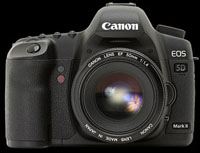
DSLRs have larger sensors and tests show that the resulting video is every bit as nice as the Red
One’s. DSLRs, however, start at less than $1,000 while the Red One costs $25,000. Big
difference.
The
most expensive DSLRs are priced below $3,000. That’s eight times cheaper than
the Red One camera, yet they feature massive CMOS sensors--some approaching 25 megapixels, 1.5 inches, as of this writing.
Another important benefit of DSLRs is that the large sensor and
interchangeable lenses allow unparalleled control of depth of field. This
enables you to isolate the subject in the frame for a more “filmic”
look.
Because of the “bigger bang for the buck,” low budget filmmakers are flocking to DSLRs.
Even established producers are looking into them for future projects or at
least questioning the relative cost of camcorders.
Drawbacks
Even though DSLRs have equal if not better image quality and are
considerably cheaper, they are prone to the rolling shutter effect (aka, “jello effect”).
This is distortion that occurs with certain types of swift movement.
If you have never seen the jello effect, examples can be found on
YouTube. Needless to say, you would not want to have a day’s shooting ruined by
this. Such a disaster can easily
offset savings in camera costs.
Until this problem is solved, you must use caution and carefully plan any
shots where the camera and/or subject are moving. That could put quite a
damper on certain types of movies.
If you are willing to risk the jello effect, you should also consider the
following essential features, which are standard on a camcorder but not
present on a DSLR:
1. Articulating Video Monitor
2. Electronic Viewfinder
3. Power Zoom
4. Zebra Stripes
5. Time Code
6. Stereo Sound
7. XLR Audio Inputs
8. Multi Channel Audio Input
9. Manual Audio Controls
10. Audio Monitoring
That’s a lot of missing stuff! Features you
take for granted on even the cheapest camcorders but not available on DSLR
cameras.
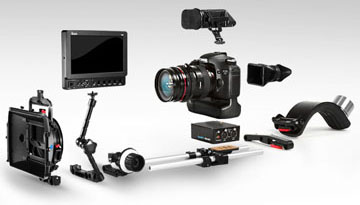
Manufactures have recognized this
and are either adding the features to the cameras or offering add-ons, as
you can see in the BH Photo promo below:
Hidden Drawback
A hidden drawback of DSLRs is that they do not record in the coveted RAW format. In addition, the video is compression to some degree, depending on the camera.
Manufactures do this to protect their high end video products. If they put all the "bells and whistles" in a $3,000 DSLR, why would anyone buy a $50,000 camcorder?
Despite this, the image quality is so great that the compression is indiscernible to all but trained eyes. It is for this reason that DSLRs have caught the attention of not only indie filmmakers, but established producers as well.
While DSLRs have certainly become a great filmmaking tool, it may be awhile
before they become a true alternative to camcorders. In any event, it looks like
there is a lot of excitement on the technological horizon!