Digital cameras have become very
affordable with broadcast quality cameras starting at under $1,000. The
very best cameras cost over $75,000. Essentially, there is a camera for
every budget. When looking for a camera, consider these features:
Sensor
In video cameras, the image is focused on
a flat electronic chip called a sensor. The job of the sensor is to convert light into an electronic signal. This signal is then recorded for later playback.
There are two types of sensors:
- CCD (Charged Couple Device)
- CMOS (Complementary Metal Oxide Semiconductor)
CCDs and CMOSs use different technologies to achieve the same goals. They both employee photoelectric sensing cells, called pixels. The main difference is in how pixel output is handled. In CMOS sensors, each pixel's charge is outputted individually, in the form of digital bits. This is the newer of the two technologies.
In CCD sensors, pixel output is grouped in the form of an analog signal that is later digitized. The grouping can involve one or more sensors. Consumer video cameras use one CCD.
Professional cameras use three, with each sensor controlling one of the three
primary colors: red, green, and blue.
After the image passes through the lens
of a three-chip CCD camera, a beam splitter trisects the light into red, green,
and blue paths. Each color beam is focused on a screen that activates the
corresponding CCD. The red, green, and blue CCDs must align precisely to
create a single image in the composite signal. This is called registration.
If registration is off, it results in color fringing and image softness.
As of this writing, the surface of a sensor can consist of up to 1,500,000 photoelectric sensing cells, called pixels. The sensor itself can vary in size from 1/2" to
1". Because pixels are the key to a camera's performance, the larger the sensor, the better the image quality.
Format
The most popular formats are
listed below, from highest to lowest resolution. Keep in mind that even
Mini DV is broadcast quality with only a 5:1 compression ratio:
-
4k (Red Digital Cinema)
-
2k (Silicon Imaging)
-
HDCAM SR (Sony)
-
Varicam HD (Panasonic)
-
Digital-S/ D-9 (JVC)
-
DVC PRO (Panasonic)
-
DVCAM (Sony)
-
DV (Mini DV)
For a detailed comparison see the lesson: Comparison of Formats.
Storage Cards
For many decades, magnetic tape stock was the standard recording medium for video cameras and audio recorders. Around 2010 this decisively shifted to removable memory card.
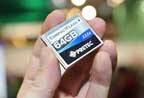
Removable memory card is now the standard for several reasons:
-
No moving parts - The cards are
small, rugged, and solid-state. Because there are no moving parts, they
are vibration and shock resistant.
-
No tape related problems - Cards have
none of the problems associated with tape, such as dropout.
-
Simplified work flow - When you are
ready to edit, just take the card and plug it into your computer.
Each shot is in the form of a file, so you transfer the files as you
would any computer file. There is no "capturing" of video, which is time
consuming.
-
Multi format - Perhaps the most
amazing aspect of memory cards is that they can record any format as
long as the camera supports it and the card has a large enough memory.
The cards have different capacities and speed class ratings. They range from class 0 to class 16, as of this writing. It is important to use the capacity and speed class rating specified by your equipment.
Standard vs. High
Definition (HD)
Resolution is the visible detail in the video image. It is
measured by the number of horizontal scan lines that make up each frame
of video.
In the US, video images contain 525 lines
(NTSC). In most Europe countries, video images contain 625 lines (PAL).
This is standard definition video.
Although much hype has been made about high
definition, the
concept itself is simple. Technically, anything that breaks the above
standards could be called high definition. The most common HD resolutions are 720p and 1080i
lines.
In 2007, the first
ultra HD
camera was introduced featuring an amazing 4,520 lines of horizontal
resolution.